Showing posts with label alchemy. Show all posts

Thursday, May 19, 2022

The GLOG alchemist: a playtest

 I previously published a GLOG class called the alchemist.  I was pretty proud of my creation, but it was a complex class, and it hadn't been playtested.  Anyone who does game design knows that no matter how "solid" something seems, if you don't playtest it, you can't be certain that it works like you intended.


The first thing I realized is that I hadn't included backgrounds.  Oops

Either come up with something good yourself, or Roll 1d3:

1: wizard.  You have no talent at casting spells, but you can detect magical items as a wizard.  You start with 2d10 silver

2: cultist:   Use the summoner class as a guide to create the cult you used (or still? belong to).  Start with 1d6 silver and a dagger.

3: Inventor:  You start with 1d12-6 gold and a peculiar crossbow that only you can use.  If  you have negative gold, you owe it to someone who may prove troublesome.


The second thing - much more important - that playtesting uncovered was that the  degradation rules and the resulting "stabilize" system just do not work well in play.  The design intent was to prevent someone building up a huge arsenal and "nova strike" with all their spells at once.  It doesn't really, and it really is penalizing to the character.  If a level 1 alchemist prepares a concoction one day but doesn't use it, each day there is a 1/6 chances of it being lost forever - those CDs aren't like a wizard's MDs, they don't "come back".  But if the alchemist doesn't, well the alchemist has no magical powers.  This is *not* ideal nor fun. 

 What we compromised instead was that alchemical preparations should have an "expiry date".   How to do that easily in game?  Simple.  Keep track of the character level at which the preparation was made, and 2 levels  higher the preparation has gone stale and is worthless.  

Example:  Kava the gooseling alchemist has made a smoke pot at level 1.  He keeps it for a while, but if he doesn't use it by level 3, it is now a dud and the CDs are lost.

So why not simply at the next level?  Well it could result in something expiring *very* fast if the PC happens to level up on the same session as the smoke pot was prepared.  

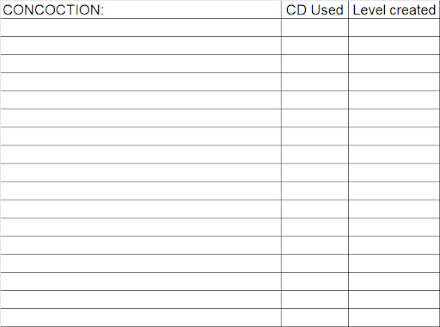
I would update the preparation tracking sheet with something like this:


Lastly, we decided that the sword of St-Germain alchemical enhancement can be used on a dagger - or any vaguely sword-like implement.  It seemed a bit silly that the alchemist could not use the sword they prepared due to proficiency issues.  

So how did it play?  Fairly well!  The alchemist basically plays a bit like a conservative mage, but can be rather good in clutch situations.   It's not for every players clearly, but my player enjoyed it.  We also found that the proposed amounts of CD was about right, at least right for my campaign pacing.  I also occasionally allowed the player to find spare CDs when it made sense, such as finding an abandoned alchemist's lab.

Of course, one PC in one campaign not sufficient playtesting, so if you too have played an alchemist, I would love to hear about it.


Wednesday, August 12, 2020

The GLOG alchemist

The Alchemist

"For the alchemist the one primarily in need of redemption is not man, but the deity who is lost and sleeping in matter."  C.G Jung


For each template (i.e. level) of  Alchemist, you can use 1 CD per concoction (max 4) You learn two formulas per template (see below).

Starting equipment:  Thick leather gloves, dagger, portable mini lab (1 slot), ingredients (see below), lots of vials.  

A:  Alchemy,  Stabilize, Alchemical tricks
B:  Scrounge, Reclamation
C:  Potion Maker, Precise Measurements
D: Discovery, Immunity

(May 2022:  please note:  see this playtest report for some revisions to this class, esp re stabilization)

Alchemy:  An alchemist's wondrous abilities are powered by "special ingredients".  They could be gems, special herbs, dragon scales, rare metals or spices... the exact nature of these can be defined with your GM, or stay vague.  A single dose of "special ingredient' is represented by a Chemical Dice, or CD.  These work similarly to Mage Dice (MD) or spell dice, common to many other GLOG magic using classes

An alchemist does not cast spells.  They create concoctions - potions, bombs, ointments - short term, one-use quasi-magical objects that the alchemist uses to create magic-like effects, based on formulas they know.  The more CD the alchemist invests into a concoction, the more powerful it will be.  An alchemist therefore needs time to prepare their concoctions in advance, analogous to a wizard memorizing spells.  An alchemist without concoctions prepared will have to rely on their wit, dagger or feet to get out of trouble.

Using Concoctions:   Most require 1 action to activate - light a fuse and throw, drink, etc.  When a concoction is used, one 1d6 is rolled per CD invested during the concoction's reaction, and the effect (for example, damage, or duration) is based on this result.  On a roll of 1-3, the CD is "returned" to the alchemist - he was stingy with the ingredients, and still has some left.  On a 4-6 the CD is lost - more ingredients were used for a bigger bang. 

Other people can use your concoctions, but it is risky - they roll 2 extra d6 that add no power to the effect but can trigger a mishap or doom (see below).

When rolling CDs, [sum] means the sum of the CD(s) rolled and [dice] the number of CDs rolled.  If two of the dice have the same number, it triggers a mishaps.  If three have the same number, it triggers a doom.

1d6 alchemist mishaps
1.  The concoction doesn't quite work right and there is a minor explosion or acid splash.  Take 1d6 damage.
2.  The concoction worked normally, but regain no CDs on a 1-3 for this one.
3.  Coughing fit for 1d6 round.
4.  A *hideous* smell is released.  People shout in panic, zombies gag.   How embarrassing!
5.  The fumes give you a vicious headache.  You can use concoctions but are in no shape to prepare new ones for the rest of the day.
6.  You drop the concoction and it goes off, to potentially disastrous results.

Alchemist Dooms  (triggered in order)
1.  Countless mishaps have permanently singed your eyebrows.  You smell peculiar.
2.  Exposure to noxious chemicals have affected your health.  Lose 1 HP permanently.
3.  You have contracted a long wasting illness from years of exposure to toxic metals.  Lose 1 HP permanently each month.   There are no know cure... but perhaps the Elixir of Life could save you!  But the formula has been long lost...

Making concoctions:  A concoction takes 1 hour per CD invested to prepare (some take longer).  This is careful work that needs quiet, some shelter and light to do.  Most alchemists carry a portable lab (2 slots) that is sufficient for most alchemical work.  If the process is interrupted the CDs are lost.  Unlike a wizard, there is no limit to the number of concoctions an alchemist can prepare - but it would not be wise for her to use all her CD in advance, as concoctions are not stable - each morning, the concoction has a 1 in 6 chance of losing one CD of power.  A concoction with no CD left has fully degraded and is essentially useless. Some alchemists deal with this problem with stabilization (see below).


Regaining CDs:  An alchemist starts at level 1 with 2d6 CDs, and she gains 1d6 more CDs each time she levels up.  Furthermore, when returning to town to re-supply, a level 1 alchemist *can* regain 1d4 CDs, at a cost of 1 gp per CD.  At level 2 and 3 resupplying will yield 1d6 CDs, and a master alchemist will be able to gather 1d8 CDs.  An alchemist does *not* gain CDs by sleeping or some special ceremony.  (please see design notes below!!!).

A skilled alchemist has also ways of obtaining more CDs by careful use of their ingredients.

Formulas:   An alchemist begins the game with two known formulas, each determined randomly by rolling 1d6 and consulting the list (reroll any duplicates).  At template B they gain two more formulas (roll 1d8 twice), at Template C they gain two more (roll 1d10 twice) and at template D they get another two (roll 1d12 once and select another).  An alchemist can also gain further formulas by consulting alchemical tomes and learning their formulas.  Doing so is difficult, taking a day (or more!) per new formula.


Stabilize : To avoid the rapid degradation of a prepared concoction, an alchemist can spend one hour carefully neutralizing it.  The concoction - if kept dry and away from extreme temperatures - will remain inert and stable for several years.  Another hour of work is required to re-activate it.  Once this is done, the concoction cannot be neutralized a second time, and must be used soon or it will degrade (as per standard rules).

Alchemical tricks:   You know one of the following minor alchemical feats (and learn one per template).  These do not require CDs:

- Matches.  You have created small fire sticks, that are useful to start fires.  You can use them to light a fire most circumstances, or provide candle-level illumination for 1d3 rounds.  If the precise number of matches becomes important, you have 2d6*5 matches, and creating a new batch takes 1 hour.

- Small firework display.  A sparkler or 3, a whistler, a half dozen firecrackers, a couple of bottle rockets, a cone fountain... it will entertain the children or make a heck of a distraction.  An alchemist investing large sums and sufficient time could make a display suitable for larger audiences, of course.

- Planetary Charm:  A small plate of lead with protective symbols.  They provide you with a +2 save bonus vs a specific thing (fire, fear, brigand attacks, poison, illness....).  Re-aligning the save takes 1 hour but must be done on the proper day of the week (roll 1d7 to determine which day).


Scrounge:  An alchemist with no remaining CDs can spend an hour searching an area (a cavern with strange mushrooms, a wooded area, an abandoned lich lab, even a small village) and gain 1 CD.  At template C this increased to 1d2 CD, and at template D this increases to 1d3 CD.  This can only be performed once a day.  This search may trigger random encounters.  Scrounging is free, unless in a village or the lich is still around...

Reclamation:  An alchemist can take apart an already prepared concoction and extract remaining CDs from them.  Roll 1d6 per CD, you regain it on a 1-4.  If the concoction is not stabilized, this roll may trigger mishaps/dooms in case of doubles or triples. This process takes an hour.

Potion Maker:   You learn the craft of making magical potions (potions of healing, giant strength etc).  The exact costs, special ingredients, special recipes etc if any, are left to your GM to determine. You can do it twice as fast as a wizard, and probably safer too.

Precise Measurement:   Instead of rolling, you can decide that a CD will be 2 (you conserved on ingredients) or 5 (you didn't skimp).  Not all dice can be determined at least one CD must be random (precise measurement can only be used on 2D or stronger concoctions).   Having multiple 2s or 5s can trigger a mishap or doom.

Discovery:  You rediscover an ancient secret of the past.  You (THE PLAYER) do some research in old grimoires etc, find a formula or spell you like, and transcribe it into the GLOG format.  You can do it - I mean you're playing this class right?   Your character will thank you.

Immunity:  Years of exposure to strange substances and dangerous experiments have granted you a +3 bonus to saves vs poison, gas, fire or acid.

Formulas


1. Fire Projector   This concoction is a tube that projects one or more fiery projectiles, each doing 1d6 points of damage to target and cast light as a torch (it can be use to set fires).  It shoots [dice] number of projectiles.  Hits are automatic within 30 feet, after that an attack roll is required (treat as a ranged weapon with range increment of 30 feet).  The alchemist can set a fast fuse (shooting all projectiles in 1 round) or slow (shoot one per round).  Also known as the Roman Candle.  You can choose the color of each projectile.

This concoction is easier to make than most, CDs are regained on 1-4, not 1-3.


2. Stone Bread  The alchemist uses sawdust, grass, dried leaves or similar materials (even dirt will do) and bakes them into a "delicious" breadish substance that is not particularly nutritious but will keep you going in times of scarcity.  Lunches does with this substance will heal half of normal.  "Bread" made this way keeps twice as long as normal bread (do not use the degradation check).  This process generates [sum] portions of "bread.

3. Celestial Perfume of the Seven Planets  This perfume is most auspicious and pleasant, making the wearer seems interesting, charismatic and worthy of assistance - if a roll is required, it provides a +4 bonus to a charisma check (or equivalent bonus).  It also keeps miasmas and plagues at bay, providing a +2 bonus to saves vs diseases.  Gnomes are particularly fond of the perfume - they know what it is, but its usage is seen as a mark of good character and style.  Once applied, the perfume lasts for [sum] hours.

4. Smoke Pot  Upon ignition, this clay pot emits copious amounts of smoke, generating a cloud of [dice] X5 feet radius, lasting [sum]/2 round (only 1 round in a stiff wind).   By varying the fillers in the pot, the alchemist can choose to generate one of two types of smoke.  The smoke can be opaque, blocking vision - the smoke is unpleasant but mostly harmless.   Or the smoke can be thinner but noxious.  Those inside the infernal stink must make a constitution save or be sickened, suffering a -4 penalty to attack rolls and ability/skill checks while they remain in the smoke and for [dice] thereafter.

An alchemist can choose to have the bomb go off almost immediately after thrown or add a fuse that will delay its activation by up to [dice] rounds.

5.  Vitriol  The alchemist generates [dice] vials of strong acid.  This acid can be thrown at an enemy (10 foot range increment, attack roll required, [sum] damage on round 1 and [dice] damage for the following [dice] rounds).  It can also be used to destroy metals (gold is immune) - a single vial is sufficient to wreck a lock, melt an iron bar etc, in about a minute.

This concoction is particularly stable, and only requires a check vs degradation every month.


6.  Theriac  The alchemist takes a large onion, cuts off the top and carefully opens it up.  Spices, poisons and other exotic ingredients are inserted between the layers, and the whole thing is slowly and gently cooked in boiling honey.  Some alchemists believe that keeping a stabilized Theriac for very long periods of time (years or even decades) enhances the effect - the flavor certainly is something.

This powerful concoction can stop illness or poison dead in their tracks. Upon eating this panacea, the patient may remake a save vs illness or poison with a +4 bonus.  Furthermore, they regain 1d3 hp per CD used.

The Theriac takes two hours per CD to prepare, not one.


7. The Great Petard  A metal sphere or tube (or a very thick glass bottle) is filled with fiery ingredients, a fuse is lit, and KABOOM.  Does [sum] damage in a 20 feet radius.  If well placed against a structure (gate etc) does double damage to the structure (DM should be generous in its breaching power.  Something like 1 D will blow up a solid door, 2D a postern, 3D a stout postern or a small gate 4D all but the greatest gates).  The bomb can be thrown up to 50 feet with a running start.  The fuse can be almost immediate, or burn for  up to [dice]X2 rounds.

This was used by Kerbouchar in The Walking Drum - that guy was pirate *and* a scholar.

8. Sword of St Germain  This concoction is a bit different from most.  A 7 pointed star made of a thin sheet of pure tin is inscribed with potent symbols under the light of the full moon.  This star must then be wrapped around the tang of a single handed sword (preferably a backsword).   The grip is then re-installed over the star.

The star will be inert (and stable) for several years until its power is invoked.  The user will then be victorious in battle.  The sword becomes a +2 weapon for [sum] hours, but only for the alchemist.

9. Mercury invisibility ring  This ring is made with solidified quicksilver and mounted with a small stone found in the nest of a hoopoe (a type of bird).  To be used, the ring must be worn with the stone facing outwards - by wearing it with the stone hidden, its power is suppressed.  The invisibility granted by the ring lasts [sum]+[dice] minutes, but it can be split up into up to [dice] uses.  A violent action by the alchemist, the use of magic, rapid motion (running vs walking) or even loud speech by the alchemist will disrupt the invisibility for 1d6 rounds.  Despite these limitations, the power of such a ring cannot be overstated, and could even be used to win a kingdom.

This concoction does not expire (i.e. is stable) until it time/number of uses runs out, when the ring melts. This concoction *must* be prepared on a Wednesday.

10. Killing Miasma  In a glass bottle, the alchemist mixes water, salt, distilled vinegar, old urine, styrax and other things, and exposes it to the light of the sun, then seals with with a good cork and bee's wax.  Upon breaking, the vial releases a cloud of noxious fumes, [dice]X5 feet radius, lasting [sum]/2 round.  While a strong wind will disperse the cloud in a single round, a gentle breeze will push it along, moving it 1d3X10 feet per round.  Anyone inside the cloud take [dice] damage.  Furthermore, anyone in the fumes for longer than their hit dice (or level) rounds must make a save vs death (or constitution check) or die.  Woe upon the alchemist who breaks his bottle by accident. It can be thrown up to 40 feet, 60 with a running start.


11.  Homunculus  The alchemist has gained mastery over life itself!   Using clay, bile and a drop of her blood; and with a full day of sculpting and  gentle baking, she has created a new living organism, the homunculus.

The homunculus can speak the creator's native tongue.  It is not particularly intelligent but is cunning and is able to improvise.  It is fairly loyal as long as it's treated reasonably well.  Its life span and potency depends on how many CDs were invested:

1D  Defense zero (AC 10), 3 HP, +0 to hit, 1d4 dmg  All stats 8.  Lives [sum] hours
2D  Defense 2 (leather), HP 5, +1 to hit, 1d6 dmg, +4 to stealth check, All stats 10.  Lives [sum] days
3D  Defense 3,  HP 8, +2 to hit, 1d6 dmg, stealth as above + can use a bow.  All stats 11, Lives, [sum] weeks
4D  Defense 3, HP 12, +3 to hit, 1d6 dmg, stealth and magic as above, can fly mediocrely on batwings, all stats 12, lives [dice] years + [sum] weeks.  Can use your concoctions.

Alchemists hotly contest claims that they are merely hiring small ugly(er) goblins.

I blame Arnold K for this!!


12.  Philosopher's stone.  The Grand Work.  Takes a full month and *must* invest 4 CD for it to work, along with a pound of lead, a pound of silver and one thousand ants, as well as access to a full alchemical lab - a portable one simply won't do.  Through a series of sublimations, condensations, combustions, fermentations, precipitations and paying close attention to planetary alignments, the alchemist prepares the philosopher's stone, the culmination of his art, a golden brown stone the size of a baby's fist.  This stone is stable until used.

But what does it do?!?

Some say that when crushed and mixed with a pound of lead, it will generate a pound of gold.

Some say that if put in the mouth of a creature that recently died (no more than a week ago), the creature will be resurrected.

Some say that if shallowed by a dragon, the stone will allow it to assume human form for [sum] days, and that dragons will grant anyone bringing them such a stone a wish.

Some say that that if dissolved in a perfect alcohol then drunk, it will instantly grant a wizard template to the drinker.


There are rumors of many other alchemical formulas in existence, such as the Ionian fire, the fishing lure, the lighting projector, the fougasse or the ritual to make frogs shut the hell up so you can get some sleep.


Concoction tracking sheet

To assist players in tracking their concoctions, which one is stabilized, reactivated, has lost partial potency etc, I created the following partial character sheet.  It's not pretty, I'm sure many of you could do better, but it should look something like this:

CONCOCTION: CD Used CD remain Stable? Re-activated?


...............................

Design Notes


A *LOT* of things lead to this class - my interest in old grimoires, and my quest for a "component based" character... and I feel like I've combined the two here.  The formulas/spells are inspired by various Grimoires I have read but also this ancient D&D supplement.  I  sincerely hope I have been successful - it feels like an achievement, but I may be deluding myself.  Depending on how I look at it, I have been working at this for a few weeks... or several years.

I also feel that the class is important because it introduces a lot of "dice manipulation" techniques, that might work for other class concepts.  This is appropriate because the alchemist doesn't get MDs every day - the CDs are harder to come by.  They therefore need more ways to retain or re-use these dice.  On the other hand, I wanted to make sure that an alchemist couldn't stockpile an arsenal, hence concoctions expiring, preparations times etc.  I hope I struck a proper balance.

Speaking of balance:

THE MOST IMPORTANT QUESTION:   Is the class getting enough CDs?   I don't know, this hasn't been play-tested, and I hope that someone will. Feedback is appreciated!  This is probably something that the GM will have to adjust during the campaign, as it will be pretty setting/pacing dependent.

I'm also not sure if I went too far on the concoction preparation time.  The class is complex, I must concede that, but the player willing to play an alchemist will probably not mind too much I hope.

Lastly, there is a ... peculiarity with the CDs returning to you *after* you use the concoction.  You are out of ingredients, you use the concoction, and oh would you look at that, I had two CDs at the bottom of my bag, silly me!   It's not great, but I'm willing to live with it.

Sincere thanks to Words for Yellow for their very valuable assistance, as well as input from Phlox and the OSR discord server community.

“Know this: I, Mercurius, have here set down a full, true and infallible account of the Great Work. But I give you fair warning that unless you seek the true philosophical gold and not the gold of the vulgar, unless you heart is fixed with unbending intent on the true Stone of the Philosophers, unless you are steadfast in your quest, abiding by God’s laws in all faith and humility and eschewing all vanity, conceit, falsehood, intemperance, pride, lust and faint-heartedness, read no farther lest I prove fatal to you. For I am the watery venomous serpent who lies buried at the earth’s centre; I am the fiery dragon who flies through the air. I am the one thing necessary for the whole Opus. I am the spirit of metals, the fire which does not burn, the water which does not wet the hands. If you find the way to slay me you will find the philosophical mercury of the wise, even the White Stone beloved of the Philosophers. If you find the way to raise me up again, you will find the philosophical sulphur, that is, the Red Stone and Elixir of Life. Obey me and I will be your servant; free me and I will be your friend. Enslave me and I am a dangerous enemy; command me and I will make you mad; give me life and you will die.”  Patrick Harpur, Mercurius: The Marriage of Heaven and Earth


Thursday, August 6, 2020

The 1700s Magic User

Consider the 1700s wizard. 

I don't mean in the game world.  I mean here, on Earth. Grimoires are being massed produced and this gentleman of some means, living in a small village a ways of Paris, has given these books some serious thought.  He can't practice too openly (the scandal!), but in his summer home on his cousin's lands, away from too much prying eyes, he dabbles.  The locals know all about it of course.


Now we KNOW that magic "doesn't work" in the real world, but you have to consider that people were much more inclined to believe in the supernatural back then.  More importantly, the placebo effect is a real thing, and it's enhanced by belief.  When someone takes a placebo and they get better... they actually are getting better.  In some cases it's just for a little while, but in other cases they are truly cured.  In other words, the "fake" part of the placebo is the remedy, not the effect.  So add the placebo effect with a bit of positive thinking and a fair bit of collective delusions and *tada!* you have a spell that "works", at least some of the time.

So our country wizard has had success at curing old Marie's headaches.  And his spiced liquor he's been preparing is pretty nice, and so is his hand soap (because some Grimoires had recipes for those too - actual formulas that sort of work).  And he's paying pretty handsomely for that high purity lime the village is known for... so of *course* his talisman against snakes totally works, you should buy one!  His ring of invisibility... well not so much, but even he'll admit that the formulae is most difficult, and that he hasn't gotten it right yet.  A man would only need to have mastered a handful of spells and be working on a few others to be considered a proper wizard, alchemist or whathaveyou. 

Some wizards will be charlatans selling snake oil and the like (some grimoires had formulas for scams, so you could, ahem, "ward yourself against them").  But I think others believed in what they were attempting to do, and in the right circumstances, so would have many people around them.   Life was hard and full of uncertainty, there was a need for "reassurances", charms against various harms.  And besides, some of their concoctions actually worked.

When women did that, of course they focused on the more practical effects (more cures, less "turn tin into silver" nonsense) and, for their efforts,  were sometimes accused of witchcraft.  That's patriarchy for you.

Saturday, July 18, 2020

Tiny Servant - the best spell ever?


How to watch Fantasia: Reviewed

Greetings friends and fellow forumites. I am the bearer of great news. D&D has a new best spell.

Those who have the newly release Xanathar's Guide to Everything will of course know that I am talking about the superlative spell, Tiny Servant.

Tiny Servant lasts for 8 hours and doesn't take concentration. But it's much more than say, Unseen Servant. It can *kick some ass*. +5 to hit? 1d4+3 dmg? Send a few of those in and beat your enemies up. Fill one up with a dangerous substance and send it after your foes - even in death, the Tiny Servant will shower your enemies with acid - or worse!


Invisible creatures troubling you? Say no more, the Tiny Servant can handle it. Need someone to hold the torch? Get the torch to hold itself! Feeling squeamish about sending your familiar on a dangerous scouting mission? The Tiny Servant's got this, they aren't unionized! Impress officials with a small box filed with gold coins! Propose to your paramour with an animated ring case! Wow your fans with your own baby-groot! Need to throw that grappling hook up but every party member has 8 strength? Have no fear, with Tiny Servant the hook will climb up the wall, and if necessary impale itself in that troublesome's guard chest!

But this spell is not only good for players. Oh no, any GM with a gram of creativity can have tremendous fun with this spell, especially in dungeons. The party found a priceless vase? It's running away, it's a Tiny Servant. The party manage to vanquish it? Oh well, oops so much for the vase! That brick wall? It's made of Tiny Servants! Oh, I found a magical dagger - oh no it's stabbing me in the face, it's a Tiny Servant!

Mark this moment my friend, we are living in exciting times. One day you will be able to tell your grand-kids where you were when you laid your eyes upon the new signature spell. Tiny Servant - the fireball for the 21rst century.


(this is from an EN world thread I started a few years back - it's worth a read.  I'm copying it here because a: the forum might crash and it would disappear, and that's a pretty good post I think! and b: easy content haha)

Friday, April 17, 2020

The Grimoire inspiration!

So when I started working on the Petit Albert translations, I had a number of goals and hopes in mind - some was historical research, some was the hope to create a resource that would be usable for gaming material.

It seems that my efforts have paid fruition, and some others have started using it as a source/inspiration for their own game!  I am *very* honored to see this happen - it is quite gratifying to have my work be of use to others!

First we have the reddit user The Secret Dino created a list of magical items clearly inspired by my work: https://drive.google.com/file/d/1hiKdah2oLtIBuMtPH9SoGDZFnrjkQJJN/view  (see the thread: https://www.reddit.com/r/osr/comments/fqn30i/petit_albert_grimoire_and_the_alchemy_blog/ - I may update this entry if they have more material)

Second the very talented and frequent collaborator Words for Yellow posted this music-inspired list of magical rituals, which clearly have roots in the Petit Albert's formulas.  That bell-based spell?  Ooof that is something!

Both have created fascinating work, and I also note in a lot more concise form than the somewhat long-winded and rambling Petit Albert text... and that's a good thing!  It makes it far more useable in a game :)    This is a great example of the DIY/collaborative nature of the OSR, and it's a pleasure being a small part of it.

Lastly, you may note that Words for Yellow wrote that post for the Secret Jackalope 2020, organized by the OSR Discord server.  I too am writing one, and mea culpa, I am already late.  But I do have something coming up!  Something UVG related too.... stay tuned.

edit:  I don't think I had any effect on this, but this is wild and should be read anyway!  https://academyofdoors.blogspot.com/2020/04/scripted-para-entropic-lexigraphical.html

Saturday, March 28, 2020

Petit Albert Grimore: Some Alchemy

Apparently, this month is the Alchemy Carnival!  What better way to celebrate than continue my long project of translating the Petit Albert, focusing this time on spells that are particularly "alchemical" in nature.

An ointment by which one can be exposed to fire without being burned.
It has been many centuries since trial by fire has been used, where criminals were to prove their innocence via exposure to fire. However, it was decided that this was not legitimate - who are we to ask God to intervene to protect the innocent? Also, there were frauds during these trials, the custom has thus been entirely abolished.


Ancient historians say that the activity of fire could be suspended. Here is the most reasonable means I could create: One must mate an ointment composed of hibiscus sap, fresh egg white, plantago seeds, powdered lye and horseradish sap. Crush and mix together well, and put on parts of the body needed to be protected from fire. Let the ointment dry, and reapply a total of 3 times. After that, you will be able to easy withstand a trial by fire without being injured.

speaking of fire....

To Make Greek Fire

This fire is so violent that it will burn all things to which it is applied and cannot be extinguished - neither with urine, strong vinegar or sand. It is made with live sulfur, tartar, tragacath (? sarcocole), alcohol (?), heated common salt, pentreole (?) and common oil. All these compounds are boiled together, until they consume a piece of cloth put within. It must be stirred with an iron spatula, and this composition must be made in a courtyard and not inside, because if a fire were to start it would be impossible to put out.


Historically, there is great uncertainty about how Greek fire was made. The uncertainty will remain, as I don't know what several of these ingredients are (sorry!) Pentreole *might* be a form of petrol?


To turn one self's invisible with the use of a fixed (solidified) mercury ring

There are reports of the famous Gyges , who gained the thrones of Lydia by the use of a magical ring, which made him invisible, thus allowing him to easily commit adultery with the queen and kill the king. Cabalistic sages have given us the method of making rings which have the virtue of invisibility.

This important operation must be started on a Wednesday (in French Mercredi, day of Mercury... but in English, day of Wotan) in spring, under the auspices of Mercury, when it is know that this planet is in conjunction with another favorable planet (the Moon, Jupiter, Venus or the Sun). Using a well purified and fixed (solidified) mercury, a large ring will be crafted, fitting the middle finger of the hand. In this ring a small stone, found in the nest of a hoopoe, will be set.

Around this ring you will engrave the following words

Jesus passing + in the middle of them + went on his way +

You will then lay the ring on a small plaque of fixed mercury, and you will prepare the perfume of Mercury. The ring, resting on the plaque, will be exposed to the vapors of the perfume three times in a row. The ring will then be wrapped in a piece of taffeta of the color corresponding to the appropriate planet (the one in conjunction with Mercury) and then put into the nest of the hoopoe where the stone was taken, and left there nine days. The ring will again be exposed to the perfume of Mercury, and will then be kept in a small box made of fixed mercury, to be used when needed.

To use the ring, put it on your finger, with the stone facing outward. The stone has the virtue of being so fascinating to the eyes of onlookers that you can be amongst their mist without being seen. If you want to be seen, twist the ring so that the stone faces the inside of your hand and then close said hand into a fist.


I'll note that for a complete recipe, I should give the recipe for how to "fix" (solidify) mercury *and* how to make the Mercury perfume, but this would be ridiculously long. Given the complexity of this formulae, one can doubt if it was ever attempted.


The author gives a modification of the recipe, involving the wrapping of a ring with the hairs of a furious hyena, in the following pattern.


He then gives a counter to the invisibility ring - another ring!:


To make a ring that will counter the invisibility ring

As there are no poison in nature without its antidote, the sage providence of the Creator has made all things in proportions, thus no artifice is without remedy. IF you want to ward yourself against the effects of the cabalistic mercury ring, you will make a ring in the following manner.

The ring will be made with lead, well purged and purified (the procedure being explained earlier in the book). In this ring you will set the eye of a young weasel, that has been with child but once. On the ring you will inscribe the words:

Apparuit Dominus Simoni

This ring will be made on Saturday, when Saturn is in opposition with Mercury. You will make three times the Saturday perfume and you will then wrap the ring in a piece of a funeral shroud. You will burry it in a graveyard for 9 days. After retrieving the ring, you will make three times the perfume of Saturn and use them.

Those who invented the ring used the principle of antipathy which is found between the maters which compose these two rings, with such opposed effect. In fact, nothing is more anathema to the hyena than the weasel. And Saturn is almost always in opposition with Mercury - when they meet in one of the Zodiac signs, it's almost always a bad omen.


A rather topical one: 

A balm against plague

This recipe is against the plague and any contagious illness. It was a present from a king of Spain to his daughter, Queen of France, that I obtain from her first
(main?) doctor, and anyone can make it due to its great facility. (... we'll see about that!)


You will rake well twelve roots of black salsify, you will cook them in three pints of white wine, while covering the pot well to avoid excessive evaporation. Once well cooked, you will press them through a cloth. To this liqueur you will add the juice of 12 lemons, half an ounce of ginger, half an ounce of cloves, half an ounce of cardamom, half an ounce of agarwood; crush everything well. You will then add an ounce each of the following herbs: rue leaves, elderberry, salvia and blackberry. You will make this all boil together at a low simmer, until a quarter has evaporated. You will then pour it promptly through a double cloth, then you will store in a jar made of strong glass and well sealed.

You will drink in the morning without food for nine days, about a third of a pint. By this mean, you will made resistant against bad air, even if you were to frequent the plague-afflicted. For those already afflicted by a contagious illness, they will add to this drink the juice of root of bulbous
(?) and of knapweed (not sure of the species here), from which they will decant a good theriac; and with this they will purge themselves of the mortifying venom. And to those who have the charbon (skin lesion caused by cutaneous anthrax), they will crush the leaves of blackberry and of elderberry with mustard seed, they will form a poultice on the charbon and, with the help of God, will heal.


Alas, this does not work against the plague or any modern pandemics... I mean I shouldn't have to say that, but with all the scams going around @_@ (don't you *dare* sell this as a cure!!)

Finally, the *classic* alchemical work, to make gold. There are 6 such spells in the book (ie less spells than love spells or fish-catching spells), here is one of them:

To change lead into fine gold:

There are people who reject the method that the wise chemist Falopius left to change lead into fine gold, because it seems too easy for such an important work. However, he is not the only philosopher who spoke of such a similar method: Basile, Valentin & Odomarus said almost the same. No matter, here is the way: You will infuse a pound of couperose de Cypre
(copper sulfate) with a pound of foundry water (well clarified by filtration), this infusion must last 24 hours so that the couperose be completely dissolved. You will distill it by filtration through pieces of clean felt, and afterwards by with an alembic in a bed of sand heated by fire. You will conserve this distillate in a jar of strong glass, well sealed.

You will then take an ounce of good fine silver
(quicksilver?), that you purified in a crucible, covered to stop evaporation, when it starts to boil you will add an ounce of fine leaf of good gold, and you will immediately retire the crucible from the fire. This being done, take a pound of fine lead, purified by the following method: Take a pound and 4 ounces (you will need excess because of losses). Melt it, then quench it in a strong clarified vinegar. You will melt it again and quench it in the juice of swallowwort; then melt it again and quench it in salt water. The last melt will use a strong vinegar, said vinegar having quenched quicklime prior to use.

The purified lead will then be melted, and then you will incorporate the mixture of gold and fine-silver
(quicksilver?) that you prepared and mix well together these three things with an iron wire. When all is well mixed, add an ounce of the couperose water and let everything digest on the fire for a short period of time. When this has cooled, you will find that the composition is now good gold.


Good luck on making gold!  (and yes, this spell was easier than the other ones...)

(the original French Text can be found here)

Saturday, January 25, 2020

Teas, Opiums, Poisons and Kojos: use in play and a few examples.

Someone on Discord wanted to expand their use of opium in a Yoon-Suin game.  I thought about sending them my notes, but then I realized I could clean said notes up and make a post out of them instead!  Two birds in one stone etc.

I have to admit something though - these were not a big hit with my players.  But I think it's not because of the "flavor" of the items (although some players distrust drugs, probably for good reason).  Rather, most of my players will be thrilled to get a consumable item and... never use them. Potions of strenght, heroism etc remain unused.  Interesting, items that are more  utility than combat oriented see more usage, but even then many items get on a character sheet and are promptly forgotten.  Some bloggers have suggested that there is a "too good to be used" phenomenon going on.  Basically, players feel "sure I could use this potion now to help me fight the ogre, but there could be a giant next week!"   And when they meet the giant, it's "but there could be a dragon tomorrow!" etc.

So you know your group - do they use consumables or not?  If they don't, don't put too much effort into these.  (EDIT:  Wombat from the OSR Discord server suggested that these should have a shelf life - use it or lose it in other words.  I never implemented this, but it seems like a good idea...)

So with that cheerful intro, here is what I've used in my Yoon-Suin Campaign so far (I've tried to exclude the examples from the book, but I might have missed some?)

TEAS
Tea of the Third quality:   day to day black tea that almost everyone drinks
Tear of the Second quality:  Green tea, quite nice
Tea of the first quality: there are usually almost never any of this tea as a "generic", everything is "special"

- Emerald Green:  1 rupee per *cup*.  Brilliant green tea, excellent.
- Fighter's brew:  Deep brown tea.  Caused lethargy and the drinker to sleep almost a full day. However, healing dice have advantage and double amount gained.  2 gp per pot
 - Mountain's delight:  Pale orange tea.  Intriguing flavor with a mineral tint.   1 Paisa a cup
 - Amethyst Jasmin, a deep purple brew with aphrodisiac properties.  Cost a staggering 80 rupee a pot as it is grown in a single farm and contains amethyst powder.
- The Yellow Tea.
- The Unseen Brew.


KOJO STICKS
- The Kojo of inner fire:  This reddish tobacco increased energy, removing up to two levels of exhaustion.  Not recommended before bedtime (and eating a solid meal is a good idea too).
- The kojo of beneficial health:  This pale grey tobacco speeds up natural healing.  All hit dice healing rolls get rolled twice and keep the highest (eating also recommended).  This effect last one day.
- The kojo of bliss:  This dark green tobacco makes you blissful for 2d6 hours.
- The Kojo of Yoon:  This dark purple kojo stick reeks of Yoon, the common purple spice used by almost everyone.  Smoking this kojo makes the smoker immune to hunger for a *week*.
- The kojo of the moon.  This brilliant white kojo stick is almost without odor and burns with an invisible flame.  Gain advantage on perception for 1 hour.
- Black Kojo:  a particularly strong kojo, no magical effect
- Pale Kojo:  a very smooth one.  No magical effect. 
- Orange Kojo:  Flavored with orange rind
- Riverweed Kojo: everyday kojo, a bit uneven in quality.
- Kojo of Endless Air.  The smoke of this Kojo is almost flavorless but tingly.  It loads the body with oxygen, allowing one to go without air for 1d3 hours (great for water exploration, also for high altitude sickness)

No prices were set for these, as they were obtained and traded with Lamarakhi clans (small rewards, favors etc)... and yet never used :(

OPIUMS:
- The Brown Imp:  A brown opium, smoked in a pipe.  Acts as relaxant tea. Save vs poison DC 12 or see demons cavorting at the periphery of vision (this save can be failed on purpose, as many users find the cavorting entertaining).  Addictiveness:  14%, DC save 10 to half the % .  Costs 7 rupees a dose.  Produced in large quantities, but expensive due to its popularity, frequently on the menu at slugmen parties and social functions.
- Jasper Judge, a black poppy:  Eaten in the left mouth.   Cause lack of sleep and keen judge of moral character.   Potency 6 (16%), save DC 11.  Costs 5 rupees a dose.  Often used by negotiators.
- Fierce Heart: A red poppy, which is smoked into a pipe.  An aphrodisiac and a stimulant, it boost energy (+1 damage for 1d6 hours).  Potency 19, save DC 14.  Costs 9 sp per dose. 
- The Rainbow Storm:  A purple opium, crushed and then mixed with boiling tea.  Hallucinogen, colors are super bright and chaotic (disadvantage to many checks) for 1d4+1 hours.  Addictiveness:  Potency 6.  DC save 10 to half the %.  Costs 4 rupees a dose

(the rules for potency and addiction can be found in the Yoon Suin book).

POISONS
- Sea's blight: onset 1d6 minutes, debilitation 1d3 days/1d3 hours, a squid that hunts sea snakes (local product), uncommon (IN 5e, debilitation is 3 levels of exhaustion... there is a 5e "poisoned" effect with is sufficient for most poisons though) . DC save is 13
- Alchemical Jug Basic poison. Skin contact onset 1d4 minutes, DC 10. Injury onset immediate, DC 12. 2D6 dmg, poisoned, check every 4 hours until pass.
- Foe-stopper: A somewhat weak poison obtained from the boxfish toxin. Save DC 12, Poisoned 1d4 rounds. A weapon-applied poison, immediate onset. Weakens muscle for a short period of time
- Black Centipede poison: Injury immediate onset, DC 13. Damage 1d10. Poisoned (save every round)

The main use for these were not by the PCs, but by the *foes*.  Brigands using poison on their arrows can really spice up a fight!

Saturday, October 19, 2019

Petit Albert spells: More translated by request spells

Continuing with my translation of Petit Albert spells as requested by the OSR reddit.  This is my second entry of these - sorry for the delay, they take time!
  

We will start with friendlier spells.


Secret of the staff of the good traveler


You will take, on the day following All Saints' day, a strong branch of elder, from which you will make a staff to your preferences; you will hollow it out by removing the pith inside, and garnish the bottom of the staff with an iron ferrule.  You will take two eyes of a young wolf, the tongue and the heart of a dog, three green lizards, three swallows' hearts, and sprinkle all these with fine saltpetre powder and dry them in the sun between two sheets of paper. This will be put in the bottom of the staff, and on top of this you will put seven leaves of vervain harvested on the eve of the Saint Jean-Baptiste, then a stone of multiple colors that you will find in the nest of a hoopoe.  You will cap the top of the staff with an boxwood cap or any other substance that you want, and you can be assured that this staff will guarantee  you against the inconveniences and perils that too commonly befall travelers; such as brigands, ferocious beasts, rabid dogs and venomous creatures.  It will also obtain you the good will of those with whom you are lodging.  


This was quite challenging to translate, and was originally a single run-on sentence.  Given the precise timing of the collection of some of the ingredients, this staff would take about 6 months to craft.  I suppose in game term this would reduce the chance of certain random encounters occurring, and improve the reaction rolls of innkeepers and other such providers of hospitality.  Treacherous peasants who rent a barn to travelers only to rob them might decide to let the staff wielder go unmolested because they have taken a liking to them, for example. 


Other on the same subject (originally being NATURAL SUBTILITIES, THAT HAVE SOMETHING TO THEM THAT ATTRACTS ADMIRATION)


I tested in Flanders the effect of a lamp to free us of the importunate croaking of frogs and to subtlely impose on them silence; it was in the castle of Lord Tillemont, whose moats were so filled with these noisy insects that one could hardly get any rest at night.  We made white wax melt in the sun with crocodile grease, which is about the seame as whale oil; and I believe that this oil would have the same effect as crocodile grease, which is quite rare in this country.  We furnished a lamp with this composition with a fairly large wick, and as soon it was lit and put on the edge of the moat, that the frogs ceased their croaking.


This is such a nice, friendly spell, with sentences of a reasonable length, alternative ingredients and a modest, laudable goal. And yes, I do know frogs are not insects... clearly taxonomy in the 1700s was a bit... vague.


To have sweet, soft and nice smelling melons.


You will obtain seeds of a good strain of melons, you will infuse them for two days in a syrup composed of raspberries, cinnamon, cardamom, of two grains (is this "two small bits" or grain as in the weight measuring unit?) of musk and of ambergris.  The syrup should not be too thick or lukewarm (it is unclear if the text meant "not luckewarm" or "but lukewarm) when you put the seeds in infusion.  You will need well prepared soil where you will sow the seeds, with a good layer of horse manure, and to be careful no to water them too much and ensure to avoid overabundant rain (no rain repeller spell in the book!).  If you are exact in all these things, you will have melons fit for the palate of a king.


To make the true water of the Queen of Hungary 


You will put in an alembic a pound and a half of fresh rosemary flowers, half a pound of pennyrile flowers (a type of mint), a half pound of marjoram flowers, half a pound of lavender flower, and on top of all of that, 3 pints of good aquae vitae (Eau-de-vie, alcohol); having plugged the alembic well to prevent evaporation, you will put it for 24 hours of digestion in steaming horse manure; then you will distill in a Bain-Marie.  The usage of this water is to take it one or twice a week, in the morning while fasting, about one dram in a liquor or other drink, and of washing the face and any limb where one would feel pain of feebleness.  This remedy renews vigor, clarifies the mind, dispels darkness (depression?), protects the sight from the failing of old age, makes the user seem younger, is beneficial to the chest (breathing? breasts?) and stomach (digestions but *maybe* keep the waist thin?) by rubbing it on: this remedy must not be heated, no matter if used as a potion or by friction (application to the skin).  This recipe is the true one that was given to Isabelle, queen of Hungary. 


Interestingly, this recipe has its own Wikipedia entry!   You will note that beyond the wild health claim this … isn't a spell at all.  It's just perfume.  It illustrate the very fuzzy relationship between magic, craft and science that existed at the time.  I am also very amused by the comparison to GOOP one of the OSR redditors made :D 


Against the inconvenience that one may receive from dogs.


You will stop them from barking at you, if you carry on yourself the dried heart and eyes of a wolf: the great antipathy between dog and wolf causes this effect, which has often been tested and proven.


Very short and simple.  Anyone could do this.


Now, we will move on to the not so nice spells...


A light that is related to the hand of glory, and makes people fall asleep.

Take four ounces of the herb known as little dragon (French: serpentine, as far as I can determine this is tarragon), put it in a closed earthenware pot, then make it digest in the belly of the horse. By this we mean in hot manure for 15 days, the herb will change in little red worms, from which you will pull (extract) an oil as per the principles of the art. From this oil you will supply a lamp, and when this lamp is lit in a room, it will cause sleep, and will make those in the room sleep so soundly that it will not be possible to wake any of them, as long as the lamp remains lit.

This is a very interesting spell, but challenging. How to make it is unclear, parts of the process are deliberately left out. Furthermore, how to *use* the lamp is not as obvious as it seems. You can make people in a room fall asleep yes, but then what? You can't enter the room, you'll fall asleep too! Probably best to take out guards so you can do something in another room. By making allusion to the hand of glory, the author is making clear that the intended use of this spell is for some kind of mischief.


A deadly Miasma

Miasma
(stink) is naturally contrary to the health of men, and it can sometimes be deadly, as witenessed by the writings of Fioraventus, who says that if you take the dirt (muck) of human blood, once the waters and serums are out of it, and after drying said blood dirt, if we mix it with styrax and we burn this in a room, the miasma that results is lethal.

The author is being very sneaky here. He gives us a death spell, and not very complex either, so that we may be motivated to learn his protection charm against it! Way to sneak in black magic in your mostly innocent book, author! (the original title of the section is "Against the diseases and other accidents that hinder the life of man")


To make a man or woman insensitive to torture, so that one would obtain nothing from their confession.

(this spell is interwoven in a long shaggy dog story about a legal process which I cut out, so it's a bit choppy)

There are those who use certain words, softly pronounced, and others use small notes hidden upon their body. Here are three verse they speak in the times they are applied shame (generic poor treatment):

Imparibus meritis tria pendant corporæ ramis.
Dismas & Gestas in medio est divina potestas,
Dismas damnatur, Gestas as astra levatur.

And here are other words spoken when they are actually being tortured: "As the milk of the blessed and glorious Virgin has been sweet and pleasant to Our Lord Jesus, may this torture and rope be sweet and pleasant to my limbs"

... we found no other thing on him that a small note on which was the figure of the three king, and these words on the other side: "Beautiful star, which freed the mages from the persecution of Herod, free me of all torment". This note was stuffed in his left ear.


The author then gives us a counter spell to the anti torture charms, in the interest of not letting clever criminals get away, clearly stating that he's on the side of the torturers. How... civic... of him...


There were a few other spells in there that are a bit... rape-ish?  Better left in the past.

And that is it for now, I'll probably do one more round :)