Thursday, October 19, 2023
The Mace of Gygax
Friday, July 15, 2022
A serious problem with 5e: the first sentences.
I wrote a way back about a hidden problem in 5e with advantage. I've recently become aware of another, perhaps more insidious problem: the flavor/fluff writing and the mechanics *do not match*.
Basically, most spells or class abilities have the format of a title, a sentence or two of fluff/flavor, then a mechanical description. But HOW OFTEN does the first sentence not really match the mechanics?!? Let me give an example that happened in play very recently:
So we had an encounter with a weird monster (I'm GMing gates of firestorm peak, an excellent 2e adventure I converted to 5e.) and the party paladin decided to "detect evil, paladins can do that in 5e right?"
So here is the power. I have put the first "fluff" sentence in italic
Divine Sense
The presence of strong evil registers on your senses like a noxious odor, and powerful good rings like heavenly music in your ears. As an action, you can open your awareness to detect such forces. Until the end of your next turn, you know the location of any celestial, fiend, or undead within 60 feet of you that is not behind total cover. You know the type (celestial, fiend, or undead) of any being whose presence you sense, but not its identity (the vampire Count Strahd von Zarovich, for instance). Within the same radius, you also detect the presence of any place or object that has been consecrated or desecrated, as with the hallow spell.
The player tried to argue that the effect would detect evil... but it doesn't! It detects fiends, celestials and undead (and consecrated/desecrated stuff). The thing was plenty evil, but it was technically speaking an aberration but it was such a vile one (and kind of undead-ish) that I ruled it as detecting evil, but RAW (and probably RAI) it shouldn't have.
In my experience, a lot of casual players are... not super aware what their powers/spells do. So they look at the name of a power, read the first line, think "that looks cool and makes sense for this situation, let's do that!" This is how they learn the game - by playing, by trying things and see how they work "live". And all these powers/spells that have a miss-match trip up these casual or new players, and there is no need for it. There is no reason why the first sentence couldn't have said "The presence of extraplanar beings and undead register on your... "
Here is another example from a few months ago, in a Drakkenheim game.
A fighter was surrounded by 2-3 foes. The party druid decided to help their fellow PC out by casting a spell at one of the bad guys. She looked at her selection, and chose Ice Knife. She cast it at the foe and... it turns out that the ice knife is an *ice grenade*, and the spell hurt everyone in the area, including her fellow PC! Let's look at the spell and what happened:
Ice Knife
You create a shard of ice and fling it at one creature within range. Make a ranged spell attack against the target. On a hit, the target takes 1d10 piercing damage. Hit or miss, the shard then explodes. The target and each creature within 5 feet of it must succeed on a Dexterity saving throw or take 2d6 cold damage.
So once again, the casual player takes a brief looks, thinks "this looks good" - and it turns out the ice knife, which sounds like a single target spell, is actually an area of effect spell. It's a good spell! But it's not what the label says, and a more "serious" player would not have made that mistake... but neither would have a casual player if the spell had been named properly.
These experiences make the game less fun and harder to learn, and could be fixed easily with better writing.
There are several more examples of this if you look for them. The cantrip friend, for example.
Thursday, April 28, 2022
A new Familiar: The Potato
Familiars are an important part of some D&D rule-sets (they are sorely lacking in the GLOG...*) and can be a fun and very useful addition to a party.
5e, 2nd ed and other editions had lists of "regular" familiars people could take: cat, raven, crab etc etc etc. But I have realized that these lists are all missing an *excellent* form for a familiar: the Potato.
Here is why:
1: No plant based familiar
2: Something people are familiar with, it's plausible.
3: SUPER stealthy. Who suspects the potato?
4: EXCELLENT guard - due to all its eyes, the Potato familiar has 360 vision. (but see point 7...)
5: Yes it has poor speed, but it can burrow.
6: In a pinch, the potato can be used as a weapon and hurled at your foes.
7: The potato makes for an excellent bribe for certain foes, esp goblins (this makes the potato a poor choice to spy on goblins).
8: in a pinch, the potato can be used to make a meal.
9: It cannot fly, but it will not get sucked into a jet engine. (thank you Dice and Doggos for that crucial contribution)
10: It can be used as a battery to power high tech devices or perhaps used as a magical focus (autographedcat came up with this one)
11: Significant RP potential.
That's a lot of utility for a simple familiar!
Now you might say "ok sure, it's the best regular familiar, but surely it doesn't beat the improved familiars like the imp". And yes, you would be 100% correct. To be in the same class as the imp, you need a turnip. Why? I have said too much already...
*edit: about that, I've been a bit out of touch from the GLOG-sphere so maybe there are several ones now out there, I thought I should note that. Also, some have asked me to generate rules for familiars in the GLOG and that is harder than in looks, since spells are "entities" of sort in the GLOG magical theory, so a find familiar spell may not make sense. A familiar in the GLOG would be something different...
Saturday, February 27, 2021
The problem with 5e? ... it's best feature.
So people have been grumbling about 5e.
(tl,dr: advantage is great! but it has consequences - the players engage less. A proposal to fix it)
I think 5e is a good game. But like all versions of D&D, it's not perfect. Compromises had to be made (I consider it "medium crunch" and I am happy with the level of complexity, but for some it's too complex, for others not enough). Some new rules had unintended consequences - the "sort rest classes vs long rest classes" balance depends on the pacing of the game, which is strange. There is no longer a "magical item market" where you could customize your magical gear - some see this as a good thing (I do!) and some see it as bad. Some say that the game is too easy, that the PCs are too tough (a valid criticism I think).
However, the advantage/disadvantage system was almost universally praised. And it is good! It was a bit... much... at times in the older editions.
This is an example from the PF game (the kingmaker AP where I play an alchemist)
"My starting to hit number is +9, but there are modifiers. I have drunk the mutagen, which gives me +4 to dex, which means +2 to hit. I've also cast reduce, which increases my attack by 1 and gives me 2 more dex so another +1. The foe is 25 feet away so point-blank shot kicks in, giving me another +1, BUT there is a -2 range penalty. The bard is signing that's +5 right? (our bards is *awesome) - nope the bard is more than 30 feet away from me, reducing the bonus to +3. I'm also firing into melee (-4) and there is some cover (-2) so that's not great... but wait I'm hasted by the sorcerer, so I get another +1! So now it 9 +4 +1 +1 +1 -2 +3 -4 -2 + 1= +12 (... I think)... vs touch attack armor"
And this will change every round - did I take just take dex damage, or been hit by a debuff? did range changes, is cover less (or more), did a buffing spell expire, the bard stopped signing, etc etc etc."
Advantage sweeps almost all of this away. With very few exception like cover, in most situations you have advantage (roll twice take the best), normal chances of success, or disadvantage (roll twice take the worse). This ended the constant re-calculations of bonuses changing from round to round. It made the game faster and easier.
But some of the discontent about 5e was more... nebulous. Some blamed the "Mercer Effect". Others that the game didn't "feel" right.
Recently, I saw this video about 5e being like super-heroes and how the character's power all came from their sheet and that the rewards of engaging with the world were less - you could just use your "own" power to win. Now this video wasn't quite 100% right. you still need the other PCs IMO. And it didn't quite explain why you didn't need to "engage" anymore.
But that video made me realize what the issue is - it's advantage! Once you have advantage, getting more help doesn't matter.
You don't need to find the higher grounds. You don't need to flank the giant. Just get advantage by doing *one* thing and you're good. And a lot of classes have ways to easily give themselves or others advantage. So you don't need to engage with the world as much! Just show up, and get ready to rumble!
So... how do we fix this?
First, Advantage is not a 2nd d20 roll. It's a +1d6 bonus. This is roughly the same as advantage (advantage is equivalent to +5 *if* you have 50% chance of hitting. If your chances are very low or very high, the impact is less. So +1d6 is roughly equivalent).
Second advantages stack - you could get more than a d6. But for things not to get completely crazy, (good or bad: disadvantage stacks too!), the extra D6 don't add, it's a "take the highest roll". So if you have advantage from 3 sources, one source of disadvantage, roll the 1d6 twice, take the best, and add this to your 1d20 roll. So if you have a *lot* of advantages, the bonus will approach +6
I *think* this might encourage re-engagement with the world and terrain, but without the excessive complexity of pathfinder/3.x....
EDIT: It's been pointed out to me by a number of people that this 1d6 solution can be found in the game Shadow of the Demon Lord. Given the amount of time I've spent on the OSR discord, it's quite possible that I saw that there, "forgot" and then half-remembered it when I was looking for a solution. I certainly don't want to take credit for something someone else thought of first!
I think that while the solution (original or not) is important, identifying the problem is my main "original" contribution. I also note that the solution would need to be play tested, as it has a major impact on the critical hit system, and a few feats.
Another thought: would this stack with bless or guidance? Yes, it would, same way advantage stacks with guidance/bless, and this should go for other "bonus dice" that 5e can grant.
Saturday, September 19, 2020
The clockwork Warlock
One of the interesting things about the 5e warlock is how varied their patrons can be. Someone (Trappy Jenkins) on the Dungeon Dudes discord wondered "what if this guy was your patron"
![]() |
| by Travis Anderson |
A number of good ideas were quickly proposed by many people - I had a small part in it (tiny servant!!!) but this isn't my creation. But then people wondered "how to preserve this?" - unlike the OSR, there isn't a strong culture of blogging there. So I offered, and here we are.
I note that Tiny Servant is a spell that "up-casts" well and that last 8 hours. A higher level warlock may have a small army of tiny servants doing his every whim. A lot of these spells can be "jazzed up" for roleplaying purposes. Eldritch blast is *definitely* some kind of arm or shoulder cannon, or perhaps an eye-laser. In a game that allows war-forged, this is a great fit.
There is definitely a lot of potential for roleplay here. The Iron Kingdoms monster manual had the iron lich ,which were both flavorful and powerful. The warlock may be pursuing the knowledge to complete this transformation. Meanwhile, the patron may be requesting of their followers to gather various esoteric items, reagents and parts - clearly they are building some grand artifact that will shake the foundations of the multiverse... the image clearly indicates a personage who is refined, polite but ... ruthless.
I repeat that this is just a draft, and not play-tested... but clearly this would be a lot of fun, and it again illustrates the strength of the Warlock class in 5e. Thank you to the DungeonDudes discord community for allowing me to host this neat content :)
Sunday, August 23, 2020
The Monkey King and the GLOG Funnel
What struck me in this show is how the "gods" are essentially level 7-9 D&D 5e characters. They are powerful and capable, but also limited and vulnerable. The Monkey King, much like a 5e fighter or barbarian of similar level, is sorely needed by the gods (he's the party tank! the lifter of boulders!) but at the same time, he is dependent on magical items and isn't really capable of doing a lot of what the others can do (like... teleport, bring people back to life, animate objects... you get the drill). Demons are more like warlocks and hexblades - not quite as powerful as the gods, but tricky and good at violence.
So how do you do that, if you want to achieve that in your game?
Start your PCs as GLOG characters. It's a funnel! But when they reach level 5, they can retire (as normal)... OR they get re-created as D&D characters. In a stroke of lighting, they are reborn - bigger, brighter and more colorful. Sure the 5e fighter still has 2 attacks like a level 4 GLOG fighter, but the 5e fighter does much more damage, can action surge, has 2-3 times the HP.... it's super-heroic! A GLOG character goes to zero or less HP and pop goes the death and dismemberment table! But a 5e character goes down? Healing word, they'll be fine. Oh shit that didn't work? Welp, better get them raised.... like Gods, 5e heroes are hard to kill.
I mean *sure* you could use the Exalted rpg system but... 5e does it just as well, just jazz up the descriptions a tad :)
So how does this go? Well petty financial concerns are gone - people will feed them, house them, out of reverence. And other gods (higher level NPCs) now notice them, and involve the party in affairs of the realms. The gods are powerful... but there are only so many of them, and they can't be everywhere at once. Let these new gods deal with the evil pirate shaman!
So a GLOG campaign can lead to a 5e campaign... AND vice versa. The campaign is wrapping up, there is a final scene. Villagers approach them with a problems - but the gods are tired and need a break. But hey says one of the gods, why don't you ask these ruffians, they look tough? They won't do it? Fine, *we'll* ask them to do it - and poof, level 1 GLOG campaign on a mission from Gawd.
That's it for the post :)
Tuesday, August 18, 2020
On the Wealth of Cities - Warhammer edition, and on the impact of low gold on a campaign
![]() |
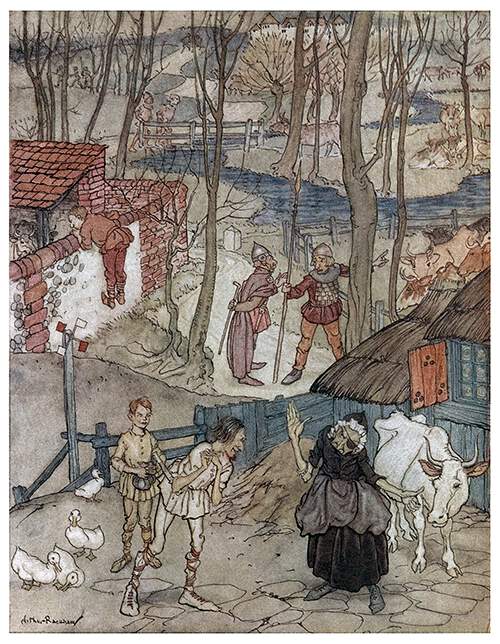
| By Arthur Rakham |
(Re laborer cost: Interestingly, if you look at the yearly income of a peasant (9-15 gp per year), the unskilled laborer is being paid on the high end of the scale. I suppose that is why the labor is available - why go work for some guy carrying stuff or digging a ditch, when you could be home peasanting instead? Because it pays more. For those with the book, compare table 5-1 and 5-18.)
At this point, I thought about doing further calculations but... that's not fun content is it? So I'm happy with the answer "GDP and rewards should be 1/4 than what they are in 5e" and leave it at that.
Buuut that isn't the case in Warhammer. Rewards in Warhammer are *small*. A mercenary makes 20-50 GP a year... and that's the kind of gold that will motivate a PC to risk their lives. It's a grim, grubby world. In the introductory adventure in the main book, the PCs are escorting a small band of villagers - not for money, but because there is strength in numbers and the area is perilous. If they are lucky, they may find a relic worth 100 gp. So 25 gp each for a party of 4 - that would be considered a *very* successful venture by Warhammer terms - it's a year's salary!
Now at first level in D&D, (multiply by 4), PCs wouldn't be too upset at gaining 100 gp each... but the difference is that the rewards never really ramps up in Warhammer, unlike D&D where finding 10 000's worth of GPs in an adventure is likely at higher level. Every new piece of equipment (armor and guns are particularly expensive relative to the rewards) is dearly needed and requires a lot of work to obtain.
And it's not just "I need armor to increase my chance of survival". The Warhammer system has a "career" system that is roughly analogous to class (2nd career adventurers would be mid-level, and third career is "high levels"). To enter those new careers so you can progress, you need the career's trappings (i.e. its gear). You can't be a knight without a horse can you? And it has to be a destrier incidentally , which is worth 500 gp. Even considering you may have started with a regular horse (80 gp) that you could sell to "upgrade", the costs are high. Not all advance careers have such onerous requirements, but you get the picture - you probably need gold to "level up".
(Interestingly, once you have entered the new career, you can lose all your stuff and still be in it - it's just to make the jump that they are needed. No renting a horse doesn't count.)
So what are the consequences of having a low-reward campaign. Well on the good side, your PCs will almost never become jaded with getting gold (in 5e you can't buy magical items easily, so PCs can accumulate a lot of cash after a while). Third Career PCs will probably be relatively well off - they already own most of the gear they want, they can afford that fat 5 gp bribe to a guard. However, if a noble offers them 1 gp a day each(!) to guard them during a month-long trip through a dangerous forest, the party will most probably accept (that would be a noble splurging for the best sell-swords in the city, essentially). I think that's a great thing...
BUT it comes at a cost. Say the party is attacked by brigands and defeat them. Their main treasure will not be coins and gems; it's going to be their gear. Weapons, armor, even clothes, supplies and utility items... They are precious loot for the PC. Even considering the loot may have to be sold for a 1/4 value to a fence that won't ask questions; it's worth doing for first-career adventurers. Third career adventurers probably won't bother anymore, but at first career.. you might not have *any* armor at all! (a full set of leather armor is 25 gp). Add living costs (roughly half a gold a week for decent living standards), and the PCs will most likely act like scavengers for quite some time.
(I will note that this has historical accuracy. The word "rob" comes from the French "derober" or "disrobe" - because brigands would literally steal the clothes of traveler's back.)
I'm not speculating about this happening during play, incidentally. I have, in the past, run a number of Warhammer campaigns, and this is what happened.
So it's a tradeoff. A low gold campaign has added tension - the PCs are hungry for money to get equipment, or even just to pay costs of living! BUT you may end up with a lot of scrounging and scavenging. In the grim perilous world of Warhammer, that's not too bad. But for some other games... this may not fit the tone you were hoping to get. Furthermore, figuring out the cost of every salvageable item takes time, and it will be something you'll have to do as a GM.
P.S. I can't help but note the parallels between some OSR system's XP system, which is based on gold earned, and Warhammer, where gold can (doesn't always) act as a "gate keeper) to the entry to some advanced classes. While both systems have flaws and benefits, I note that I find the Warhammer system to be superior. Both systems make the PCs hungry for money, not combat (combat in Warhammer is dangerous!) but it avoid adventures "having" to have money (because otherwise the PC would not advance), which bothers me to be frank.
Sunday, August 9, 2020
30 years of gaming characters
This is pretty long, so you can skim, there is a conclusion at the end :)
High school and undergrad:
1 A fire wizard. (Advanced Fighting Fantasy). I don't have a sheet of this character, only some memories, and I think this was my first character. Based on The Elves and the Otterskin, which had an interesting fire mage at the begining. There were probably a few others (a dwaven fighter I think? Maybe that one was the first?) but it's too long ago. Interestingly, the Advanced Fighting Fantasy is what gave birth to Troika! We played in this system for about a year then switched to 2nd ed AD&D.
2 A dwarven Cleric probably named Durin (2nd ed AD&D). Played from level 1-5 ish. My first D&D character. Clerics where not great back then, but hey we have to have a healer! After 5-6 levels I got fed up and we got a henchman to do that instead, and I switched to my next character which was:
3 Ajax the wild mage - my first "really good" PC, wild mage from level 5 to 9 (when the campaign ended). 2nd ed, still fond memories. We did some undermountain, we did some ravenloft, some underark... Had a cloak of the arachnid and frequent user of Wall of Ice. Gave my DMs nightmares with the "there-not there" spell. We had a really good campaign going - 2 fighters, an invoker, a wild mage, cleric henchmen, a psionisist and a paladin. The GM alternated between the paladin, the invoker and myself - when the party had two wizards going... we could dish out mad damage. Once near the end, we were attacked by a pirate ship and just... obliterated the enemy ship.
![]() |
| hand drawn PC photos are the best no? |
4 Smoshiborg Protosulfureux: a Gnome thief illusionist in a Ravenloft campaign, level 3-5 2nd ed. Had a golden dagger +2. The 2nd ed thief was weak by itself, but as a multi class it was quite good and really expanded your gaming *and* roleplaying potential.
5 Dain? Nain? A dwarven war cleric using the 2nd ed skills and powers rules, in ravenloft *very* OP, was almost as good as a fighter with almost full cleric spellcasting. He was the first character with "I don't want to be here, I want to go back home" problem that would cause him to find ways to shortcut adventures. (the GM and I had to have a talk). Level ... 3-7?
Off to gradschool!
6 Durin (?), a dwarven fighter, a mountain guide. He really should have been a ranger, but this wasn't allowed in 2nd ed (good riddance on that rule!). Short campaign but fond memories of it - first one after I left home, introduced me to new friends (who started a high level campaign).
7 Smoshiborg 2.0: a Gnome thief illusionist 2.0! The abovementioned friends wanted to do a high level campaign, so I brought Smosh back! (level 11-14) This guy had escaped Ravenloft and was very paranoid, but relieved to be back to the forgotten realms… and then become stuck in this temple of Helm a few hundred miles from Waterdeep, stuck because it's being sieged by a demonic (devilish?) army (probably the hordes of dragonspear castle module?). Tons of players (8?), but eventually fizzled out because we kept killing demons and it kept making no difference. This ended up being our last 2nd ed campaign, and also my highest level campaign ever.
8 Cedric: A human cleric in 3.0 then 3.5, level 1-9, in a *great* Greyhawk campaign. Cleric of St-Cuthbert with memory problem. Full on COD-zilla, but also very good roleplaying character - zealous but also pragmatic, a hard balance to navigate.
I could write a post about this campaign alone. For a while our two main fighters had raven-lycanthropy. So in a hard fight, they would get so hurt they would shift, the rest of the party would run away, and the 2 were-raven would *demolish and eat* the opposition.
10-11 A dwarven Evoker an a dwarven druid. level 2-7 maybe? We did a portion of the mega-dungeon return to the temple of elemental evil. Eventually we had a fight with 2-3 members escaping and the rest dead or captured. This "halfway to TPK" became an effective TPK as we discussed ways to rescue this and just gave up. (added this in edit, completely forgot this).
12 A dwarven ratcatcher (in warhammer frpg 2nd ed). Fun game, but the players wanted to stick to D&D
13 A Dwarven fighter/rogue (warhammer setting, 3.X system), also a sort of holy warrior of the god of death (more neutral funereal god, not kill everyone god). Pretty brutal combo. Low level D&D works for Warhammer but past level 5 it doesn't really work anymore.
14 Barracuda, A "leader/spy" in an Archer game, a d20 spy/combat system. Very high tech system. One of the very few female characters I have played.
My contact with this group ended a few years after gradschool
Sometimes during this time I also joined a new group, that did *not* play D&D
In the introductory part of the campaign, a modern "fey live among us" urban fantasy, I played an arms dealer. We used the gurps system.
16 Rupert, the professor/hermetic mage. Still in Gurps, still same campaign. Human, British, an academic with a sword cane, very fun to play. Even then, 15 years ago, I was interested in old grimoires. His moment of glory was saving a critically injured party member on the roof by casting a short but very strong defensive spell on said member, pushing him off the roof, then doing the same to myself and jumping off too. He then managed to drag the injured character to safety while evading police that were converging on the very *loud* battle scene.
I think we ended up blowing ourselves up?
17 Robert the half-japanese street samurai. Still the same urban campaign but we are now switching to the far more complex Hero (champion?) 5e system. He is recruited by an arm of the RCMP that keeps an eye on the fey living among us. Very sneaky, very powerful in a melee fight. Also very determined and disciplined.
The campaign ends in an attempt by our heroes to stop "the end of the world" but we explode because one player *didn't tell us about the bombs*. This player, which I still play with to this day, never lost this habit of sometimes not telling the other PCs crucial bits of information.
the "saving the world" doesn't quite work. Aliens - "angels" - come to earth and take over. Things are very messed up, much destruction etc. A new campaign in this world begins...
18 Julien Flamel. (Hero 5e revised edition) A slightly mad, very determined and *extremely paranoid* mage. His main shtick was beside some fairly basic magic, was, due to a summoning mishap, he could "exchange place" between his normal self and a multi tentacular being from the 5th dimension. This thing was a combat monster and surprisingly sneaky for a 800 pound land squid. It usually ate foes. This was inspired in part by the Words of Changing from a Tad Williams novel.
The character evolved by having more interesting spells, like the ability to summon flying turnip golems, or turn incoming bullets into mushrooms. Unfortunately, we came to a point where we had to gamble with the goddess of death to get a very important macguffin. Another PC was *designed* to be a great gambler. But the player *choked*. He couldn't risk his precious character. So Julien, aware of the extremely high stakes and very determined, gave the other PC a disgusted look and took the gamble and... lost (without those gambling bonuses, it was a 50/50 chance). wan-wan-waaaaaan.
19 Jacob: The replacement character. A gunsligner with a cyborg eye and a huge revovler, who saw the "angels" as an affront to God. Given that this was Hero 5e, his gun hit ridiculously hard. The GM took it away but it didn't really matter. And that was the end of this long urban fantasy campaign - 2 systems, 4 PCs and over 5 years of gaming.
20 Edward the Eel Lawyer (hero 5e). We are switching to super heroes. My character has aquatic powers, which we all know are lame. So I also made him a lawyer! He once stopped a fight dead in its track by shouting "I WILL SUE YOU!!!". Eventually he had to fight in another battle, and the other PCs (and the GM, who had forgotten), were horrified to realized that he had an inner second jaw like a Moray Eel that could bite the heck out of people.
We switch gear to a simple system and D-level superheroes.
21 Procyonor, ex lab assistant who gained powers after biting an activist who was bitten by a radioactive raccoon. He can summon racoons. LOTS of them. But he doesn't control them! Another PC, Cheese Lord, is *very* nervous.
22 A fashion police hitman: Hitman on the run, part of a mob that was involved in the world of fashion. Now part of a cleanup crew. Has a carcano rifle he stole from a museum that was involved in a very famous crime. Part of the cleanup involved tons of raccoons. Campaign ends with world destruction.
23 kangaroo-like necromancer. A time traveling game. He became his own great-great-great-grandpa
We then started playing in exalted
24 A solar exalt - a diplomat/swordsman/sailor. Could attack 8 times in a round rolling 18 d10 each time. Dear lord.
25 A starfish alien ("hiver") in a Traveler game that fizzled out.
26 brawler/coatch driver , exalted 3e this time. Would get his clients to their destination no matter what.
At this point, my association with this group ended, after a good dozen year together :/
27 Gamil, dwarven alchemist part of a very decent Eberron campaign that went from level 3 to 8. The character was tough as nails and fun to play. I was using a PF class in 3.X and it sort of worked, except for alter self which turns out to be quite broken due to huge AC boost...
Meanwhile, one of the player played a bard who was pretty good at boosting the party but had middling dex, light armor, no defensive magical item, refused to use defensive magic and had *no* constitution bonus. I built my alchemist knowing that our "fighting line" was mobile and skirmishy, so he was tough. The bard had to be rescued *all the time*.
28 A civilized goblin mechanic mage: Part of an Iron Kingdom campaign that went on for a few levels (2-6?). It was very interesting - I think that Iron Kingdoms is better than Eberron.
29 A starwars clone heavy gunner: In saga (I think?) system star wars game. We played crammed in one guy's bedroom... not ideal. It was a good game though, but as many campaign, it eventually fell apart. A bit too much combat, a bit too samey... PCs... but I have to give it to the GM, there was a lot of good stuff too.
I wanted to try playing 5e, so I joined a number of Play By Post games on the EN World forums:
30 Darwinimar: a great bout of collaborative world building. I really wanted to play a gnome ranger, and we really needed a tank, so I made a sword-and board short sword wielding character. It was fun, but campaign fizzled out. Level 3-4
![]() |
| Darwinimar (made with Heroforge) |
31 Grassnoll, a goblin warlock. He pretended to be a dwarven wizard (mask of many faces). He also had a patron elder god, the king in yellow, that *already had been summed back to the world*... just hadn't arrived yet, it's a long way! Campaign fizzled out. Level 3. Grassgnoll and darwinimar returned as minor NPCs in my Yoon-Suin campaign
![]() |
| Grassnoll (source?) |
32 A Dwarven alchemist. Nautical campaign, fizzled out fast. Level 4?
![]() |
| what was your name again? Source? |
33 Lal Kalandar. Mystical Barbarian I grew tired of making characters for nothing in PBP, and this guy was in *three* campaigns - one level 1-5, one level 3, and one level 11-12. They all fizzled out, but overall it was a good experience - I wanted to show that the barbarian class had a lot more roleplaying depth than what is usually depicted (stats weren't great though). He wasn't an ordinary barbarian, he had the hermit background - a dervish type, a mendicant. He also was a planar traveler - it was the same person in the 3 campaigns. The last one was an Al-Quadim campaign and I'm sad it didn't work out... although I mean it lasted almost a year and had a few very cool scenes so... that's a win?
![]() |
| Now Lal I remember! Hisorical documents |
34 Udit the riverman a thief (level 4-8) who was an NPC in my Yoon Suin campaign. He wasn't well optimized because he was meant to duplicate the Yoon-Suin version. In this one he was in one of two campaigns that did the same dungeon at once - I think at one point we had 3 groups going, eventually merged into one. This was the first time I played a single class rogue, and you know what? Bravo WotC, bravo, you nailed the rogue in 5e. We were in a dungeon with various factions, an undead dragon etc... it was *wild*. Great GM, feel grateful for his hard work. Udit also came back as an NPC in my yoon-suin game
![]() |
| Udit was a pessimist |
35 Kalorn. Warlock hexblade5 /eldrich knight 3. Very tragic, hard hitting Gish. A bitter mercenary with a "demon" leg that was grafted on him against his will. I wanted to try something new so in a new arc he replaced Udit. He had a bat familar - he would kill anyone who hurt it.
![]() |
| Now *this* is an image! by theDURRRRIAN |
36 Rodrigo. 1-5 dex-based battle-master fighter with the spy background, fought with a rapier . Very fun character - we all made PCs "blind" and we ended up with an archer, a ranger, a paladin, a monk and a fighter. Played Tomb of Annihilation.
![]() |
| What if Aragorn was a musketeer you say? (seriously, from the Alatrise film) |
At this point, after the pandemic bringing me down, and growing frustrated with the PBP method of play, I left Rodrigo and Kalorn behind. BUT I didn't just disappear from the face of the earth like some people do - are they alive? Did they die? I don't know! I had a farewell post. Remember folks, if you decide to leave a PBP campaign, SAY SOMETHING.
In 2018, one of my players and good friend invited me to his face to face campaign. It's Pathfinder which... is not my favorite... but the gaming has been good.
37 Malbung Ikrum: Level 7-10+ bladebound Magus. I had been intrigued by the Magus, and my friend told me they needed more melee oomph. So I made Malbung, the half elf half eldarian magus. His father was a bodyguard of the now dead Eladrin Godess of war. He hits hard, debuffs, is sneaky and has extremely high intimidate *and* the enforcer feat. Casts no shadow and can speak with the dead. Uses "defending bone" and claims it's Mr Magoo, the old janitor now helping him on quests. The campaign is Zeitgest and it is *very very* good. My only wish was that it was in 5e - Malbung is already restated as a bard college of sword 6/hexblade 3, I'm ready! :D
![]() |
| The clothes are wrong but the feel is right. By Matt136 |
38 Telchar (dwarven alchemist level 1-6, juust reached 7 I think) The same group has a rotating campaign, so I decided to bring back the dwarven alchemist, this time in a proper PF game. We are doing the Kingmaker campaign and it's been pretty good. Trap-breaker template
44 Melenvagor: Level 1-5 Kensei Monk. We were going to play the Dragon of Icespire Peak campaign. As this was a "beginner" adventure, I decided to make a very "classic" concept. I wanted a very elfy-elf - inspired in part by a line in the Hobbit (or maybe LOTR?) where an elf explains that he doesn't know what a Hobbit means by "magic" - it's just things elves do. And I decided that the best way to do an "elfy elf" - super dexterous, fast, strange powers, excellent archer, good in the wild - was to make a Kensei monk, with the outlander background. It worked *extremely* well. Our party was strong with archery, and we used it to destroy many a foe. Initially he fought with a sword or a bow, but one day we found a +1 battle-axe under the sea made from a megalodon tooth and ... he became Melenvagor, the Axe-Elf .
Note the ominous shadow cast by the little goblin
![]() |
| Source: https://www.deviantart.com/mattrhodesart/art/We-are-NOT-taking-the-wizard-626887777 |
Conclusions
So what can learn from this: There are definitely some commonalities in my characters: I like playing dwarves, I like playing spellcasters (and in 5e, warlocks in particular) and/or swordsmen, I like playing characters that are tough and can fight (it's not rare for me to have high saves and AC). Roleplaying wise there is a strong element of paranoia, determination and *discipline*. The paranoia is natural - our PCs are under threat! But I think that the disciplined, hard working/training PCs reflect a desire that *I* was that driven and disciplined. Oh well.
I'm also realizing that I almost never get to *play* the specific system I want to - if I want that, I have to *run* it. I wasn't able to play 5e until 2020 for example
Very few campaign last more than 2 years, so the GM shouldn't lollygag too much if they have plans. My GMing technique, when I have "no plan" is to have 2 introductory adventures *max* and then take a moment to scope the land - where is this going? Has a theme, a trend, a party goal emerged? If so, let's go in that direction! If it's utterly directionless, then you need to give some direction. Use or write a module.
The last thing I'm realizing reading this is how privileged I am regarding pen and paper RPGs. I miss the good old days where we would have a 12 hour session every week... but on the other hand, I play in one session 4 hours a week and run a 3 hour session every 2 weeks (so 6 session per month). Edit: the pandemic increased that to 4 session run per month and play in 6 others That's... pretty good! It's only possible if you can make gaming a priority - and not everyone can do that. (edit: I later cut back to 6 sessions a month, 10 is just not sustainable)
edit: Throne of Salt inspired others: https://lapidaryossuary.blogspot.com/2020/08/wanna-see-all-my-d-characters.html , https://xenophonsramblings.blogspot.com/2020/08/a-short-history-of-my-characters.html , https://madqueenscourt.blogspot.com/2020/08/let-me-tell-you-about-my-d-characters.html, https://whosemeasure.blogspot.com/2020/08/i-have-been-so-many-people.html , probably others... it's trending :P
edit part deux: this trip down memory lane made me realize that the system issues of yesterday made me appreciate some of my modern games more. But I now have very fond memories of the old games! :) That's why 5e does for me a little, it has echoes of 2nd ed :)
edit part three: MOAR blogs! https://aloneinthelabyrinth.blogspot.com/2020/08/sofinho-and-his-heteronyms_11.html , https://blog.orphredhair.com/2020/08/my-roster-of-characters-oh-me-oh-my.html , https://osrdread.blogspot.com/2020/08/25-years-of-my-gaming-history.html , https://princesses-and-pioneers.tumblr.com/post/626371173102616576/personal-player-character-compilation
edit part 4: when I first wrote this blog I hadn't played any 5e, I've now updated it to mid 2022. I hope you too have kept playing!
Saturday, July 18, 2020
Tiny Servant - the best spell ever?
Greetings friends and fellow forumites. I am the bearer of great news. D&D has a new best spell.
Those who have the newly release Xanathar's Guide to Everything will of course know that I am talking about the superlative spell, Tiny Servant.
Tiny Servant lasts for 8 hours and doesn't take concentration. But it's much more than say, Unseen Servant. It can *kick some ass*. +5 to hit? 1d4+3 dmg? Send a few of those in and beat your enemies up. Fill one up with a dangerous substance and send it after your foes - even in death, the Tiny Servant will shower your enemies with acid - or worse!
Invisible creatures troubling you? Say no more, the Tiny Servant can handle it. Need someone to hold the torch? Get the torch to hold itself! Feeling squeamish about sending your familiar on a dangerous scouting mission? The Tiny Servant's got this, they aren't unionized! Impress officials with a small box filed with gold coins! Propose to your paramour with an animated ring case! Wow your fans with your own baby-groot! Need to throw that grappling hook up but every party member has 8 strength? Have no fear, with Tiny Servant the hook will climb up the wall, and if necessary impale itself in that troublesome's guard chest!
But this spell is not only good for players. Oh no, any GM with a gram of creativity can have tremendous fun with this spell, especially in dungeons. The party found a priceless vase? It's running away, it's a Tiny Servant. The party manage to vanquish it? Oh well, oops so much for the vase! That brick wall? It's made of Tiny Servants! Oh, I found a magical dagger - oh no it's stabbing me in the face, it's a Tiny Servant!
Mark this moment my friend, we are living in exciting times. One day you will be able to tell your grand-kids where you were when you laid your eyes upon the new signature spell. Tiny Servant - the fireball for the 21rst century.
(this is from an EN world thread I started a few years back - it's worth a read. I'm copying it here because a: the forum might crash and it would disappear, and that's a pretty good post I think! and b: easy content haha)
Saturday, November 30, 2019
The Mandalorian, 7 samurai, and gaming as pizza
(This will contain vague spoilers for episode 4 - nothing specific, but you'll learn the "general shape" of the episode).
Episode 4 has the same basic scenario as the Seven Samurai: farmers plagued by bandits ask wandering mercenaries to help. This basic scenario *really* works well - it's been redone in the Magnificent Seven (twice!), the Mandalorian and many others, in various eras and settings. It also works perfectly for an adventure. It works so well, and has been done so frequently, that it's almost like pizza. Pizza is great, but it's not original. It's also easy to do, but if you don't put any effort into it, it can be a pretty boring meal. So to avoid this being a ho-hum peperoni and cheese frozen pizza of a game, let's look at our toppings shall we?
The farmers/villagers/peasants/people who need help:
Getting these people right is important. They can't be abject cowards. They aren't resisting now because they *know* it's a hopeless battle. But hiring the PCs is changing the odds - there is hope now, and they will be willing to fight. They have to be sympathetic, and they also need a reason why they simply haven't fled their area. Maybe it's good farming land, they have a lot of infrastructure built (building huts and fences is a lot of work!). Maybe their ancestral burial grounds are nearby. Whatever it is, they have to stay. The villagers should have a bit of money buried somewhere to pay the PCs. Not a fortune, but for penniless sell-swords, enough to try. Lastly, making them interesting in some way certainly is recommended - they could be farming something unusual, have strange customs, even have wondrous or useful abilities (clearly, not battle abilities). Basic relations, petty rivalries etc. can also be fun. Every village has an idiot, after all.
The bandits/raiders.
This faction has to be dangerous, but not so dangerous it's ludicrous (if they are so bad-ass, why are they wasting their time picking on a small village?). They are actually *farming* the village: raiding periodically to steal food/valuable, but not doing so much damage to destroy it. They want to be back - in fact they probably have to, they need to eat! This indicates a certain level of intelligence and discipline... but they also aren't that smart - if they were, they would set themselves up as feudal lords and tax the peasants instead of raiding them. They need to be powerful enough that a 1vs1 fight with a peasant will result in the brigand winning, but a 1vs1 vs a PC should be a fight that the PC will win... however there are a lot of them, too much for the PCs to defeat by themselves. The peasants will have to help - but they are willing to do so if they are given hope.
The special weapon.
Things can be made a lot more interesting if the bandits have some kind of "special weapon". Maybe it's an ogre. A small cannon or a catapult. A spellcaster. A troll or some other big monster. A small tank. Simply their leader, or some unusual tactic. Whatever this is, it is what is giving them such a big edge over the villagers and is making them bold and confident enough to be raiding entire villages instead of travelers or isolated farms.
The party will have to deal with this special weapon to achieve victory. In the Mandalorian, Mando had spare blasters to equip the villagers with, but he didn't have some kind of "anti X gun" to simply eliminate the raider's special weapon. They needed a plan, effort and a bit of daring. Likewise, the party will have to be clever and courageous to neutralize the special weapon. If they do, and kill a few of the bandits, the rest of the villagers should be able to win relatively easily, if they are properly prepared that is.
The party
The party needs to be powerful enough to make a difference, but not so powerful they can just crush the brigands while the villagers cheer and applaud. The timing of this adventure as part of your campaign matters. The party need the villager's help to win, or at the very least they need a good plan and good fortifications. I think level 2-4 would be ideal. Level 5 there is a bit of a power jump (in 5e at least) but it could still work, since in 5e low level creatures have better "to hit" numbers (a 2nd ed goblin has a thaco of 20. a 5e goblin has +4 to hit, ie the equivalent of thaco 16).
In the Mandalorian the "party" is higher level (I would describe Mando as level 5-7?) but fewer in numbers. An aspect that made the show interesting was that the party was "new" (the Mando and his ally didn't know each other at fist), but I think it would be preferable if the party, in a D&D game, have worked together for a few adventures at least. It *could* be a good starter adventure to unite the party, but this will be a bit more challenging to run. Even for an established group, this could mark the turning point in how the party sees itself - not just a rag tag of tomb robbers - but heroes too.
In the Mandalorian, Mando also had a special objective (defend Baby Yoda) but this isn't necessary for the scenario to work well. However, having some kind of vulnerable (but maybe useful?) NPC they have to protect on top of the general mission could be interesting?
The preparations and terrain.
The terrain should be interesting and varied - there should be opportunities for the villagers and party to put down crude fortification (barricades, a ditch etc.) and traps, funnel the enemy in subtle ways, hide a flanking team, whatever. The proper set up should give them a good edge over the bandits, or at least even the odds.
Hopefully, the PCs should be able to arm the villagers somewhat (missile weapons would be best) and train said villagers, so that their massed fire gives the edge to the party/villager alliance. Even improvised spears could help, as some of the bandits will try to close in and rush the barricades. Besides basic weapon training, the villagers should also learn what their part in the battle plan is. The kids shouldn't fight directly, but maybe they can be used to put out fires, activate traps and otherwise help. Almost everyone can pitch in, but the villagers won't accept some of them being used as cannon fodder.
It is possible that the village also has a "special weapon" of its own, but clearly it's not usable at the moment - something has to be done to assemble it, activate it, repair it, recruit it, create it, whatever. Perhaps they are beekeepers and some of the bees could be weaponized? If the party comes up with a clever idea, let them! It's important that this be a winnable fight, but it doesn't have to be the way you thought of as a GM, just a way that is plausible and fun.
For the love of god, don't roll for every single peasant and bandit! It will take forever and not be fun. The battle should be narrated in the background, and the PCs should turn the tide by reinforcing areas that are buckling, and by taking out the "special weapon". Once the special weapon is out and a number of bandits have been killed, the rest run away, not to return - they know this village is too tough for them now. They aren't fanatics, they just wanted to steal their food or valuables.
The aftermath.
The party gets their reward and moves on! Will some of them decide to stay behind and become farmers? Why not? It could be a good point for someone who doesn't want to keep their current character to retire said PC and start anew.
Another alternative of course is that this village becomes a base of operation. Maybe there are other adventures to be had in the area?
If you get most of these ingredients right, you can have a few very good sessions with this scenario. It won't be the most original, but everyone loves pizza.
Special thanks to Words for Yellow for discussion and feedback on this topic!
Monday, November 11, 2019
The strange spells of the Yellow City
Fomend’s Beating Sphere, level 2
An alternate form of flaming sphere, that does low damage (1d4) but also pushes people down (shoving at strength 16). The sphere has a reaction action that it uses to slam people trying to move away from it. When the spell works "well" it will shove down the victim and them bounce up and down on said victim until death ensures. The spell is a giant leathery ball that bounces around with a satisfying "boing!".
Cow of Auraly, level 2
A spying spell that works via a cow. Once enchanted, the caster hears everything the cow hears for the next 24 hours. Involves big yellow runes painted on the flank of the cow.
Finger of Enftebtemang, level 1
An attack spell by the infamous mage Enftebtemang (who did everything in the most complicated way possible), this spells switches the caster and target into an alternate, accelerated time stream. Over the course of several days, while the rest of the world appears frozen in time, one of the fingernails of the caster grows tremendously and stabs the victim (who is frozen but aware of the proceedings) in the face. This inflicts 1d12 damage, and the victim has disadvantage on its next attack, save or ability check due to disorientation. The user of the spell is recommended to bring food and water and perhaps a good book.
Conjure Velemert, level 3
Casting time, 10 minute. Material component: goat yoon curry on rice (consumed)
A risky spell that conjures the arch-mage Velemert, who has no head and a face of the palm of his hands. Velemert is annoyed at being summoned but will answer a single question (knowledge +10 arcana, history, +5 to other checks) if placated (Persuasion 15). If insulted (failure by 10), attacked, intimidated or simply annoyed by a caster who's too slow to ask a question or doesn't understand what's going on, Velemert grows angry and casts magic missile at the summoner (or someone else who insulted him), sneer, and vanish. If the magic missile is countered somehow, Velemert will laugh and vanish (but next time he's annoyed, he'll use another attack spell, possibly fire bolt). If Velemert's inclined to answer the question, he will answer with confidence and authority, no matter if he actually knows the answer or not (ie, he will rather lie that admit not knowing something). Once Velemert has answered the question OR blasted the summoner, he disappears in a puff of purple smoke.
Conjure Velemert can only be used once per day (and if someone else used it first, too bad for you!) and as a result the spell is a closely guarded secret. Velemert resides in Baitadili.